


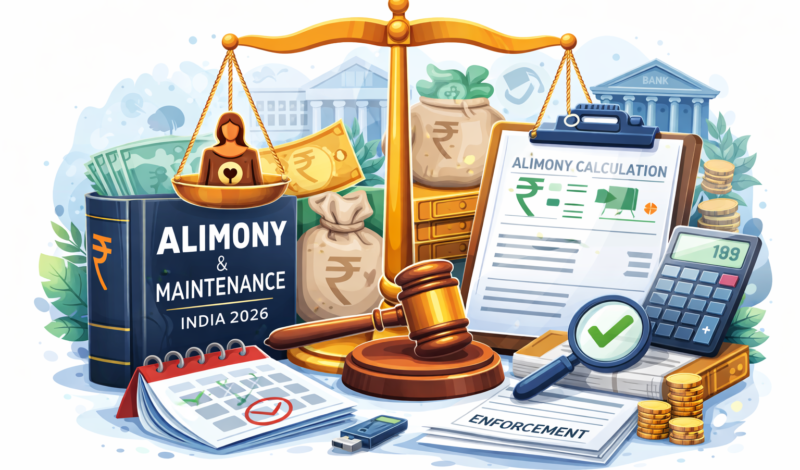

Alimony and maintenance are critical aspects of family law in India, providing financial support to a spouse or dependent after separation, divorce, or in cases of desertion. With evolving societal norms and judicial interpretations, understanding alimony rights, calculation methods, and enforcement mechanisms in 2026 is essential for anyone navigating family disputes.
Understanding Alimony and Maintenance
Alimony refers to financial support provided by one spouse to another after divorce or separation. Maintenance, on the other hand, can include spousal maintenance, child maintenance, or maintenance for dependent parents. In India, the laws governing alimony and maintenance are primarily found in:
The Hindu Marriage Act, 1955 – Applicable to Hindus, Buddhists, Jains, and Sikhs.
The Special Marriage Act, 1954 – Applicable to all communities in the case of civil marriages.
The Muslim Personal Law (Shariat) and Muslim Women (Protection of Rights on Divorce) Act, 1986 – Governing Muslim marriages and maintenance rights.
The Code of Criminal Procedure, 1973 (Section 125) – Provides maintenance for spouses, children, and parents irrespective of religion.
Courts recognize the fundamental principle that a spouse should not be left destitute following separation or divorce. Maintenance ensures financial stability, sustains the standard of living, and addresses needs such as housing, education, medical care, and daily expenses.
Legal Rights of Spouses
In India, either spouse can claim maintenance, but eligibility and entitlement depend on several factors:
Marital Status and Duration – Longer marriages may justify higher maintenance.
Income and Earning Capacity – Courts assess both parties’ incomes and potential to earn.
Age and Health – Elderly or ill spouses may receive higher support.
Child Custody – Parents with custody of minor children are often entitled to additional maintenance for child-rearing expenses.
Lifestyle During Marriage – Courts aim to ensure the maintenance preserves a reasonable standard of living, though not necessarily the same as during marriage.
Calculation of Alimony and Maintenance
Calculating alimony or maintenance is nuanced and considers multiple factors:
Gross Income of the Paying Spouse – Includes salary, business profits, investments, and other assets.
Needs of the Receiving Spouse – Daily expenses, education, medical needs, and lifestyle.
Duration of Marriage – Short marriages may lead to temporary support, while long-term marriages may justify permanent maintenance.
Child-related Expenses – If minor children are involved, courts often fix maintenance separately for them.
Spouse’s Earning Potential – Courts examine whether the dependent spouse can earn in the future and adjust maintenance accordingly.
In practice, courts may award maintenance as:
Lump Sum – One-time payment to cover future needs.
Periodic Payment – Monthly, quarterly, or annual installments, often reviewed periodically.
Combination – Partial lump sum with ongoing periodic payments.
Enforcement of Alimony and Maintenance
Securing alimony is one aspect, but enforcement is equally crucial. Indian law provides several mechanisms for enforcement:
Filing under Section 125 CrPC – The claimant can approach the magistrate if the spouse refuses to pay maintenance.
Contempt Proceedings – Non-compliance with court orders may lead to contempt of court and penalties, including imprisonment.
Attachment of Property or Salary – Courts may direct attachment of the paying spouse’s salary or movable/immovable assets to recover dues.
Negotiated Settlements – Many couples opt for mediation or alternative dispute resolution to finalize maintenance amicably, reducing delays and litigation costs.
Recent Trends and 2026 Updates
In 2026, Indian family law has seen evolving trends:
Courts increasingly recognize digital evidence like WhatsApp messages, emails, and bank statements to determine financial capacity and lifestyle.
Maintenance for same-sex couples and live-in partners is gaining judicial attention, expanding the traditional scope of alimony.
Periodic reviews of maintenance orders are now more common, allowing adjustments based on changing incomes, inflation, or child needs.
Emphasis on gender-neutral maintenance ensures that financial support obligations are fair and equitable, regardless of the spouse’s gender.
Practical Tips for Claimants and Respondents
Document Income and Expenses – Keep detailed records of salary, bank statements, and financial commitments.
Preserve Digital Evidence – Emails, transaction records, and communication logs can support claims.
Legal Counsel – Engage a family lawyer to navigate the process, draft petitions, and represent effectively in court.
Negotiation and Mediation – Consider alternative dispute resolution to reach amicable settlements, often faster and less adversarial.
Conclusion
Alimony and maintenance are essential tools for financial protection in family law cases. Understanding legal rights, calculation methods, and enforcement procedures in 2026 can ensure fairness and prevent financial distress after divorce or separation. With courts embracing modern evidence and gender-neutral principles, both claimants and respondents must stay informed and work with experienced legal professionals to protect their interests.