



Bail is a fundamental aspect of the criminal justice system in India, ensuring that an accused person is not unnecessarily detained before being proven guilty. In 2026, with evolving legal interpretations and digital court processes, understanding how to obtain bail has become more important than ever. Whether you are a legal professional, a concerned family member, or an accused individual, knowing the correct procedure can make a significant difference in securing timely relief.
What is Bail Under Indian Law?
Bail refers to the temporary release of an accused person from custody, subject to certain conditions, while the trial is pending. It is based on the principle that a person is presumed innocent until proven guilty. The provisions related to bail are primarily governed by the Code of Criminal Procedure (CrPC), 1973.
Courts grant bail to ensure that the accused appears for trial without being subjected to unnecessary detention.
Types of Bail in India
Understanding the types of bail is crucial before proceeding:
1. Regular Bail
Regular bail is granted to a person who has already been arrested and is in police custody or judicial custody.
2. Anticipatory Bail
Anticipatory bail is granted before arrest, typically when a person apprehends arrest in a non-bailable offense.
3. Interim Bail
Interim bail is temporary bail granted for a short duration until the final hearing of a bail application.
Bailable vs Non-Bailable Offenses
The process of obtaining bail depends on whether the offense is bailable or non-bailable:
Bailable Offenses: Bail is a right, and the police or court must grant it upon fulfilling basic conditions.
Non-Bailable Offenses: Bail is not a right and is granted at the discretion of the court based on facts and circumstances.
Step-by-Step Process to Get Bail in India
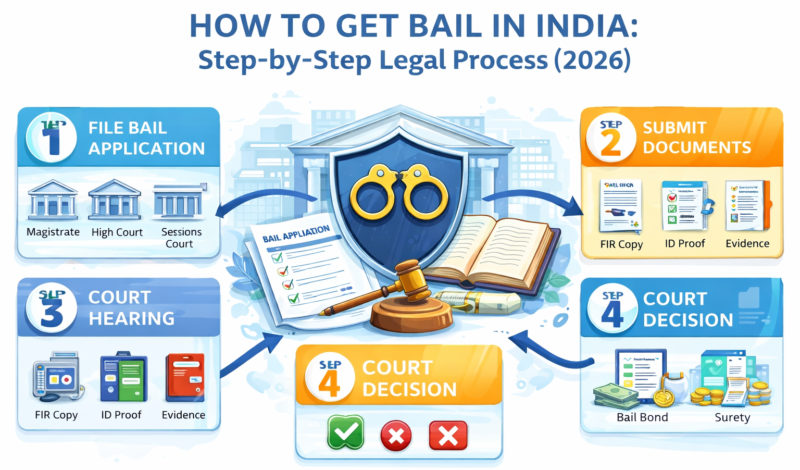
Step 1: Filing the Bail Application
The first step is to file a bail application before the appropriate court. This can be:
Magistrate Court
Sessions Court
High Court
The application must clearly state the facts of the case, grounds for bail, and reasons why the accused should be released.
Step 2: Drafting Legal Grounds
A well-drafted bail application includes strong legal grounds such as:
False implication
Lack of evidence
Cooperation with investigation
No criminal antecedents
Medical or humanitarian reasons
An experienced lawyer plays a crucial role in presenting these arguments effectively.
Step 3: Submission of Documents
The bail application must be supported by relevant documents, including:
Copy of FIR (First Information Report)
Identity proof of the accused
Address proof
Medical records (if applicable)
Any evidence supporting innocence
Step 4: Court Hearing
Once the application is filed, the court schedules a hearing. During the hearing:
The defense lawyer presents arguments
The prosecution may oppose bail
The judge evaluates the merits of the case
Step 5: Court Decision
After considering all factors, the court may:
Grant bail with conditions
Reject the bail application
Grant interim bail
Conditions may include:
Furnishing a bail bond
Surrendering passport
Regular court appearances
Step 6: Furnishing Bail Bond
If bail is granted, the accused must submit a bail bond along with sureties. This ensures compliance with court conditions.
Step 7: Release from Custody
After completing all formalities, the accused is released from custody.
Key Factors Considered by Courts
Courts evaluate several factors before granting bail:
Nature and seriousness of the offense
Evidence available against the accused
Risk of absconding
Possibility of tampering with evidence
Criminal history of the accused
Health and age considerations
A balanced assessment ensures that justice is served without compromising individual liberty.
Important Documents Required for Bail
To ensure a smooth bail process, keep the following documents ready:
FIR copy
Arrest memo
Identity and address proof
Passport-size photographs
Property documents (for surety)
Income proof of surety
Medical certificates (if needed)
Proper documentation strengthens the bail application and improves the chances of approval.
Legal Strategies to Improve Bail Chances
1. Strong Legal Representation
Hiring an experienced criminal lawyer ensures proper drafting and presentation of your case.
2. Highlighting Weak Evidence
If the prosecution lacks strong evidence, it can significantly support the bail application.
3. Demonstrating Cooperation
Showing willingness to cooperate with the investigation builds trust with the court.
4. Establishing Social Roots
Proof of permanent residence, family ties, and employment reduces the risk of absconding.
5. Filing at the Right Court
If bail is rejected at a lower court, you can approach a higher court for relief.
What Happens If Bail is Rejected?
If the court denies bail, the accused still has legal remedies:
File a fresh bail application with new grounds
Approach the Sessions Court or High Court
Seek interim relief in urgent cases
Persistence and proper legal strategy can improve the chances of success.
Recent Developments in 2026
The legal landscape in 2026 has introduced several improvements:
E-filing of bail applications
Virtual court hearings
Faster case tracking systems
Increased focus on personal liberty
These advancements have made the bail process more accessible and efficient.
Common Mistakes to Avoid
While applying for bail, avoid these mistakes:
Providing incorrect information
Submitting incomplete documents
Ignoring court conditions
Delaying the application process
Not seeking professional legal help
Avoiding these errors can prevent unnecessary delays or rejection.
Conclusion
Bail is a critical legal remedy that protects individual freedom while ensuring justice. Understanding the step-by-step process, required documents, and court procedures can help individuals navigate the system effectively.
In 2026, with the integration of digital systems and evolving legal practices, obtaining bail has become more streamlined, but it still requires careful preparation and expert guidance. Acting promptly, maintaining proper documentation, and seeking professional legal assistance are key to securing bail successfully.
Being informed about your rights and legal options ensures that you are better equipped to handle challenging situations within the criminal justice system.